 PepWay
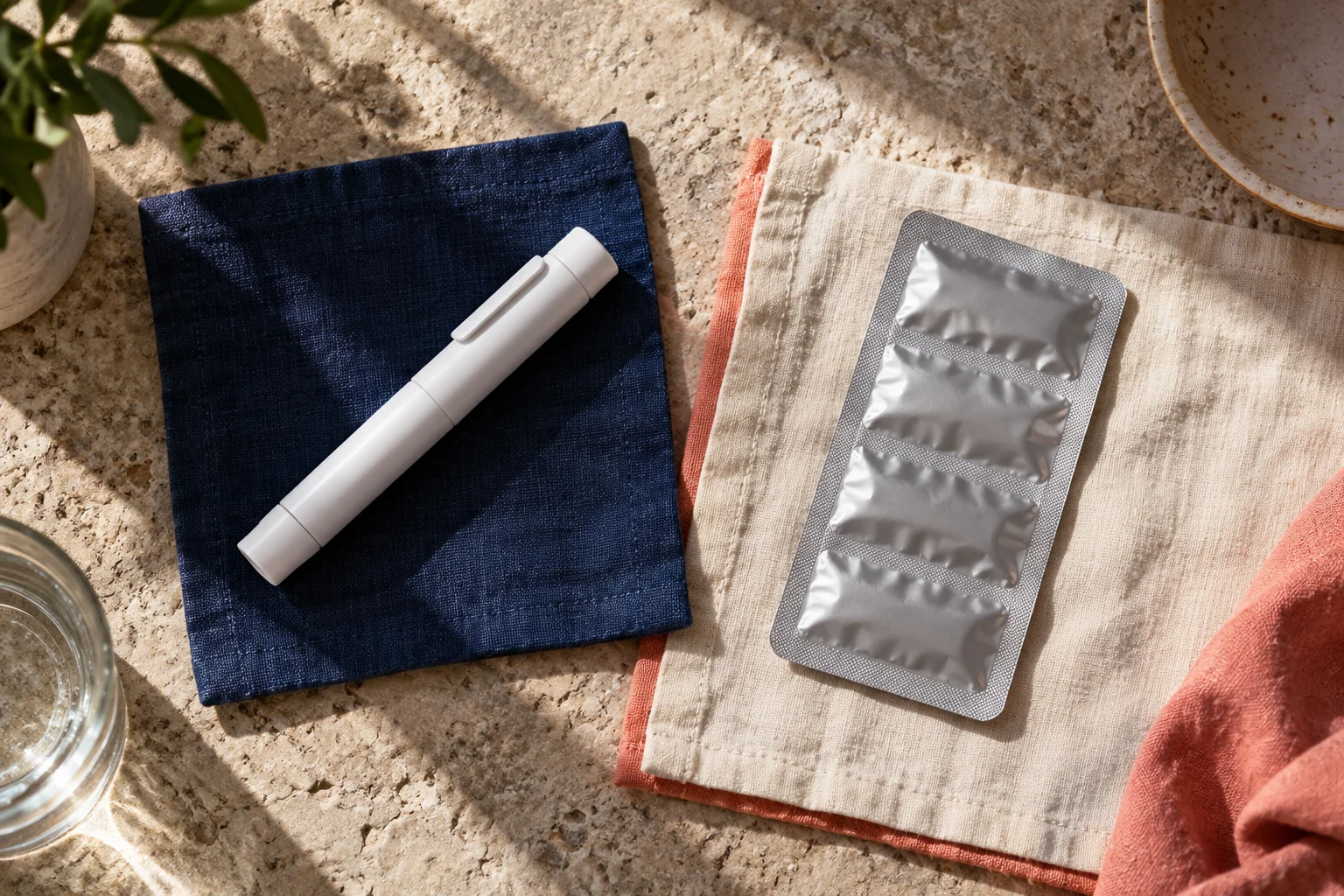
A medicine’s formulation changes the details that need checking and remembering. A pen and a tablet are more than different-looking objects. Identifying the exact product helps prevent copying one routine into a different formulation without the necessary professional clarification.
Start with a complete product identity
Write down the active ingredient, brand, formulation, manufacturer and country of the product information used as your reference. The FDA documentation reviewed includes oral and injectable Wegovy, demonstrating why “GLP-1 always means a pen” is outdated in the United States context. It does not establish which versions are registered in Brazil. Nor does it make every tablet, pen or compounded preparation equivalent. Confirmation should refer to the packaging you received and the clinical guidance applicable to your own circumstances, rather than to a broad product category.
Practical information depends on the formulation
Oral and injectable medicines may have different instructions for use, storage and their relationship to other events in a routine. Do not resolve those differences through visual comparison, memories of another treatment or an app calculation. Ask the pharmacist or healthcare team which parts of the product information should remain accessible. Keep the correct document and the date you checked it. When receiving a new formulation, review guidance again instead of automatically duplicating every field from the previous record. A familiar brand name does not make that review unnecessary.
Keep the unit beside the number
An isolated number can mean different things: the amount per unit, concentration or a packaging specification. Preserve the unit when copying professional instructions. If two labels appear inconsistent, retain the original wording and ask for clarification. Do not use the comparison to calculate equivalence between formulations. A readable record should also distinguish the prescribed plan from packaging information. Keeping these separate prevents the total quantity in a container from being mistaken for the individual event planned in treatment. Uncertainty should remain visible until a qualified professional resolves it.
An example check after a formulation change
Imagine receiving packaging that looks different from the previous one. Before updating your routine, list the complete name, formulation on the label, guidance date, reference document and unresolved questions. A note might read: “received a different formulation; need to confirm with the team which reminder fields should change.” Mark details as confirmed only after obtaining clarification. If the change was professionally advised, preserve its date in the history so you can explain why later entries do not follow the same format as earlier ones.
Treatment selection requires an individual conversation
Preferences, clinical conditions, availability and ability to follow instructions can inform a decision, but format alone cannot identify the best choice. Avoid presenting results from different studies as a direct contest between pens and tablets. Ask whether an appropriate comparison addressed the specific question and whether it matches your indication. In everyday life, organized records help explain practical difficulties and understand professional guidance. They cannot establish equivalence, substitute products or select a formulation for you. Bring unresolved product questions to the team before altering your personal routine.
Frequently asked questions
Can tablets and pens use the same recorded amount?
Do not interpret numbers as equivalence. Information must be checked for the specific product and clarified with a qualified professional.
Does FDA approval establish Brazilian registration?
No. FDA and Anvisa evaluate products in different jurisdictions. Confirm the Brazilian status of the exact medicine and formulation.
Sources and references
Documents and research consulted for this article. Each source describes its own context; a reference does not confirm every use of a substance.
- Wegovy tablets and injection: prescribing information (opens in a new tab)FDA · Accessed October 14, 2026
- Prescription Medications to Treat Overweight & Obesity (opens in a new tab)NIH / NIDDK · Accessed October 14, 2026